Kawasaki has re-entered the scooter market with the new Brusky 125
Scooters continue to dominate the motorcycle market in the Philippines, with a recent report from the Motorcycle Development Program Participants Association, Inc. (MDPPA) showing that they accounted for 65% of total sales in 2025. Thanks to their ease of operation, which is literally just “gas and go,” scooters have become the go-to mode of transport for people fed up with the country’s unreliable mass transport system, as well as for those working in motorcycle taxis and on-demand delivery services.
Now, Kawasaki, long known for its pantra models and affordable leisure bikes, is aiming for a slice of the scooter market with the Brusky 125.
Features
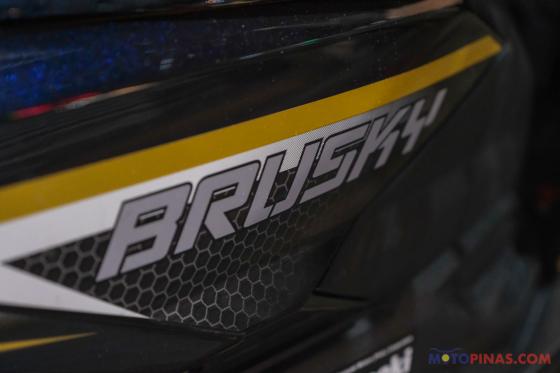
Introduced in 2024, the Kawasaki Brusky 125 marks the brand’s return to the scooter market after a decade-long absence following the discontinuation of the Curve 115. Essentially a rebadged Malaysian Modenas Karisma EX 125, the Brusky 125 sports an overall modern and sleek design reminiscent of Honda’s Click 125.
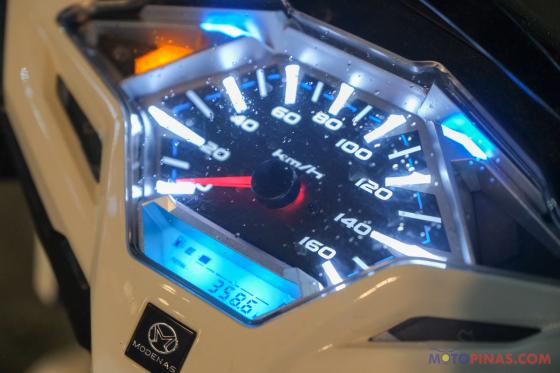
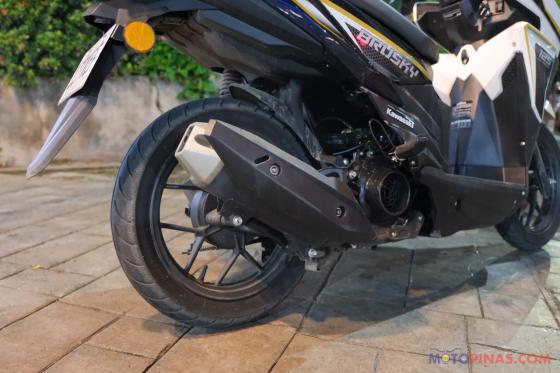
Under the bodywork, it’s powered by an air-cooled 125 cc EFI engine delivering nearly 10 PS of power and 10 Nm of torque, making it ideal for city commuting. Riders also get full-LED lighting, an analog-digital instrument panel, a USB charging port, and 14 L of underseat storage. The scooter rolls on alloy wheels, features a front disc brake, and comes with a 5.1 L fuel tank.
Riding the Brusky 125
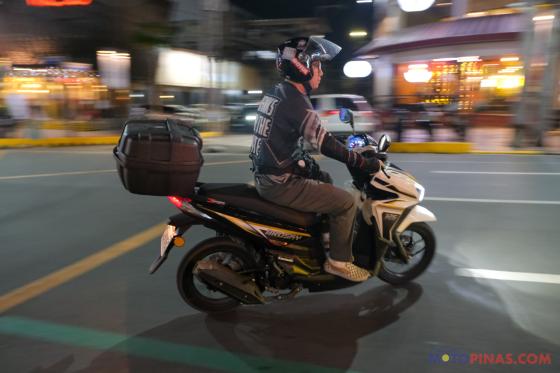
Since my personal scooter is a Honda Click 125, I can’t help but compare it to the Brusky 125. In terms of acceleration, the Brusky feels a bit gentler than my Click, and its top-end speed lags slightly behind as well. But we’re not racing on the streets, and racing isn’t what the Brusky is built for. For everyday practical riding, it shines with smooth acceleration and just the right amount of power to get you from Point A to Point B comfortably.
I also appreciated the suspension on the Brusky as it feels softer and more comfortable than my Click over rough patches. The overall riding ergonomics are solid for a scooter in this class, making it perfectly suited for daily commutes or delivering items for our brothers and sisters in the on-demand delivery services sector.
As for fuel economy, I managed 38 km/L in city riding, which is pretty decent for my riding habit, though still slightly below my stock Click 125, which averages around 40 km/L.
Where the Brusky 125 clearly beats my Click 125 is in stopping power. Its two-piston front caliper paired with a 220 mm disc delivers stronger, more immediate braking. On the Brusky, the brakes feel right on point, while on my Click, I usually leave extra stopping distance, and I’m already considering upgrading to a better caliper and disc.
It may sound like a small detail, but it isn’t. With only two tiny contact patches keeping a scooter upright, braking performance can be the difference between riding home safely or not at all.
Like the Click 125
As I mentioned earlier, the Brusky 125 sports a modern, sleek design reminiscent of the Honda Click 125, and I mean that as a compliment. The Click 125 has a huge aftermarket ecosystem, and the good news is that many of those parts can likely be used on the Brusky 125. Take my own Click 125 top box, for example. Since the Brusky shares much of the Click’s design, I figured I could try swapping the rear grab rail and monorack to make it fit. To my surprise, the Click 125 monorack lined up perfectly with the Brusky’s bolting points, needing only a few DIY rubber dampers to make it snug.
I’m not 100% sure about the other parts since this was just a test unit, and I couldn’t go wild with mods. But judging by how similar it looks to the Click 125, I’d be willing to bet that an aftermarket exhaust, side mirrors, and even step board accessories could slot right in, with maybe just a little DIY magic.
Overall
The Brusky 125 really shines in its simplicity, especially mechanically. It sticks with an air-cooled engine while most modern scooters are going liquid-cooled, meaning fewer parts, less to maintain, and less to break. That’s a big deal for our brothers and sisters in motorcycle taxi and on-demand delivery services, where every peso saved goes toward food on the table or school fees without compromise.
The Brusky also scores points for mod-friendliness. Some parts, like the rear top box rack, are compatible with Honda Click 125 accessories, making upgrades easy—just like I did with my own Click’s top box.
At a suggested retail price of PHP 77,000, the Brusky is PHP 4,900 more affordable than Honda’s Click 125, money you can put toward a decent branded helmet instead of the tabo helmet that often comes with scooters from dealers.