6 things every MC Taxi rider needs to know about new LTFRB memo
Motorcycles remain the fastest, relatively affordable, and practical way to get around, especially in heavily congested cities where even a short trip can stretch into an hour because of traffic. Recognizing this, the government launched the Motorcycle Taxi Pilot Study in 2019 to evaluate the safety and viability of motorcycle taxis before eventually drafting a law that would legalize the industry.
The road to legalization, however, has been far from straightforward. Between the COVID-19 pandemic and years of legislative delays, the industry has continued operating under a pilot program. It wasn’t until March 2026 that the Department of Transportation (DOTr) issued Department Order No. 2026-006, providing the legal framework that allows motorcycle taxi services to continue operating under the supervision of the Motorcycle Taxi Technical Working Group (MC Taxi TWG) while lawmakers work on a permanent law for the industry.
To keep motorcycle taxis running in the meantime, the Land Transportation Franchising and Regulatory Board (LTFRB) issued Memorandum Circular No. 2026-048. The circular lays down the rules governing motorcycle taxi operations under DOTr Department Order No. 2026-006, allowing the service to continue while maintaining safety and regulatory oversight.
Allowed motorcycles
Under this memo, the LTFRB only allows certain types of motorcycles for MC taxi use. According to the agency, only scooters, underbones, and pantra models are allowed and should have at least 100cc in engine displacement.
Additionally, electric motorcycles are also allowed for MC taxi use, provided that their minimum nominal power is at least 1.5kW (1,500 watts).
1 rider, 1 motorcycle taxi
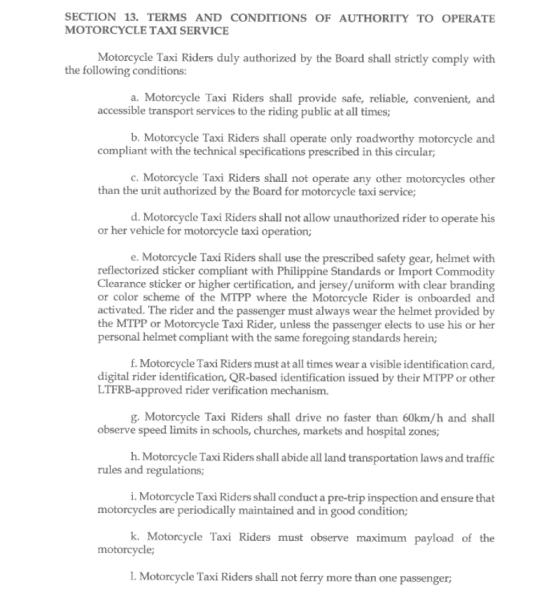
One of the biggest points in the new guidelines is that riders can’t simply switch motorcycles whenever they want. The motorcycle used for operations must be the one authorized under the Motorcycle Taxi Platform Provider (MTPP).
The rules also prohibit riders from allowing another person to use their accredited motorcycle for motorcycle taxi operations. That means practices like having a ka-relyebo (reliever) rider take over your unit are no longer allowed under the guidelines. In short, the rider and the motorcycle are linked under a single accreditation.
If you’re planning to replace your motorcycle or make changes to your registered unit, you’ll need to go through the proper approval process first.
60 km/h speed limit
The LTFRB has also made it clear that motorcycle taxi riders must not exceed 60 km/h while carrying passengers. Riders must also observe lower speed limits in areas such as schools, hospitals, churches, and public markets.
This doesn’t replace existing traffic laws. Instead, it makes the speed limit part of the operating rules that motorcycle taxi riders are expected to follow.
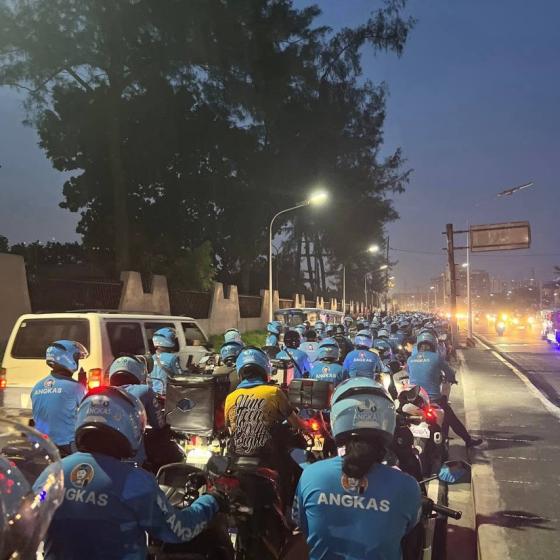
Photo courtesy of Angkas
No street hailing, no habal-habal, no multiple MC taxi apps
If you’re an accredited motorcycle taxi rider, every passenger must come through your platform's booking system. The memorandum prohibits riders from accepting passengers through street hailing or operating as a habal-habal outside the accredited platform. It also bans riders from operating under multiple motorcycle taxi platforms at the same time. For example, a rider accredited with Move It cannot simultaneously accept bookings from Angkas or another motorcycle taxi platform.
The only exception mentioned in the circular is that riders may also operate under a Private Express and Messengerial Delivery Service (PEMEDES) platform.
Minimum riding gear required by law for both rider and passenger
The new rules place a strong emphasis on safety, and the law says motorcycle riders must wear a motorcycle-specific helmet that is compliant with applicable Philippine Standards, and must wear closed-toe shoes.
That said, MC taxi riders are required to wear the prescribed safety gear, along with their company uniform or jersey and official identification. They must also provide passengers with a helmet that complies with Philippine safety standards, unless the passenger chooses to use their own compliant helmet.
It’s a simple rule, but one that’s easy to overlook. If a passenger shows up wearing something like a bicycle helmet or simply a baseball cap, the rider is still expected to provide a compliant motorcycle helmet before the trip can begin.
Riders may refuse a passenger when a trip isn’t safe
Not every booking has to be accepted, and the memorandum gives riders the authority to refuse passengers in situations that could compromise safety. This includes people who appear to be under the influence of alcohol or illegal drugs, passengers whose physical condition makes motorcycle travel unsafe (overweight), children who don’t meet the legal requirements for riding on motorcycles (RA 10666), visibly pregnant women, and anyone who poses a safety or security risk to the rider.
Turning down a booking may not always be popular, but the new guidelines make it clear that safety takes priority.
Aside from these points, the memorandum also reminds riders that they may carry only one passenger at a time, charge only LTFRB-approved fares, honor mandatory fare discounts for qualified passengers such as students, persons with disabilities (PWDs), senior citizens, and national athletes covered by Republic Act No. 10699, maintain a valid professional driver’s license with the proper motorcycle restriction code, avoid smoking or vaping while on duty, and keep their motorcycles in safe operating condition through regular inspections.