New robot friend introduced by Honda
Honda has partnered with a Spanish hospital to officially introduce an AI-powered social robot called ‘Haru’ to help enhance the lives of children undergoing long-term treatment.
Honda Research Institute Japan Co., Ltd. (HRI-JP), a Honda R&D subsidiary responsible for the research of cutting-edge technologies, has developed the 12-inch high compact desk-top robot that has been successfully trialed with young cancer patients at the Virgen del Rocío University Hospital (HUVR) in Seville, Spain.
Its effects have been very positive, with 95% of children becoming more actively engaged with their rehabilitation since trials began at HUVR in 2021, with Haru able to guide patients through their programs while engaging them in conversation. Given these positive effects, the trial will now move to full utilization of the robot, with 10 units being introduced to the facility’s pediatric oncology unit until 2027.
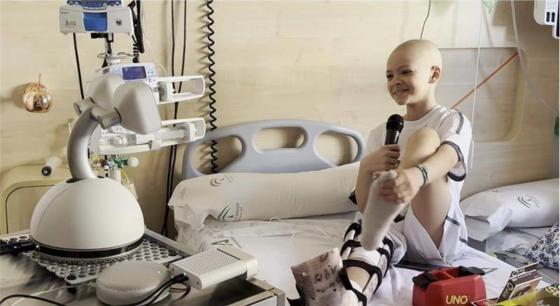
Haru obtains biometric information about the user, such as facial expressions and voice tones, through its built-in camera and microphones, then analyzes the information obtained to understand the person’s current state. It then interacts with them in accordance with the result of this analysis, using empathetic expressions and emotionally supportive responses. It can also be linked to a wristwatch-type wearable sensor worn by the user to analyze their condition in greater detail.
Haru can therefore not only encourage children to more enthusiastically react to their treatment, but it can also help neuropsychologists more efficiently undertake emotional and cognitive assessments – with the potential to increase the number conducted per year by almost nine times, going from 510 to as many as 4,500.
“We are delighted by the result of our joint research with Virgen del Rocío University Hospital that shows Haru has been able to be a companion to the children at the hospital, lifting up their spirits, and bringing smiles to their faces. Moving forward, we will continue our efforts to further advance Haru as a robot that can co-exist with people 24/7 and be more helpful to young patients as well as all hospital staff to contribute to the well-being of the hospital as a whole,” said Satoshi Shigemi, of HRI-JP.
Haru can also connect the rooms of children in the hospital with their schools online, giving them the opportunity to receive education together with those in the classroom and to interact with other children. As a robot, Haru does not have any human attributes, such as gender, race, or nationality, and is always capable of communicating from a neutral perspective. This enables it to effectively facilitate conversation beyond generational and cultural differences, especially in groups.
HRI-JP developed Haru as a “tangible AI system” to be part of a society where robots can coexist as partners and facilitate communications that create connections among people.