LTO clarifies aftermarket mufflers not illegal by default
The debate over motorcycle exhaust modifications has been going on for years, with riders and authorities often finding themselves on opposite sides.
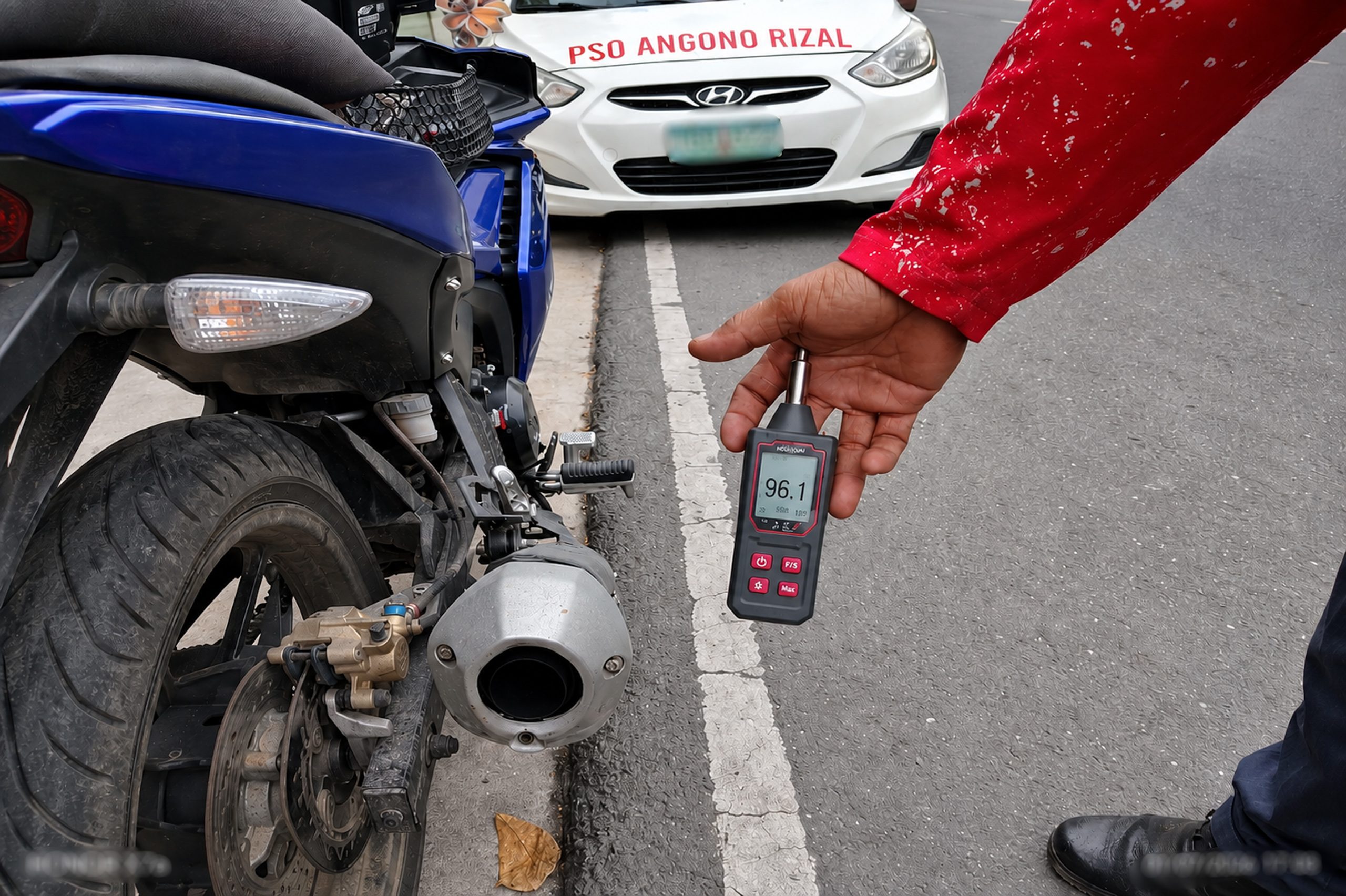
Those in favor argue that aftermarket mufflers are legally imported and sold in the Philippines and can be used as long as they comply with government requirements, including the applicable 99-decibel sound limit.
Critics, meanwhile, argue that modified exhausts contribute to noise pollution and disturb communities. Some also question their impact on road safety. The issue has become a recurring source of tension between riders and authorities, with several local government units (LGUs) also cracking down on what they consider illegal exhaust modifications.
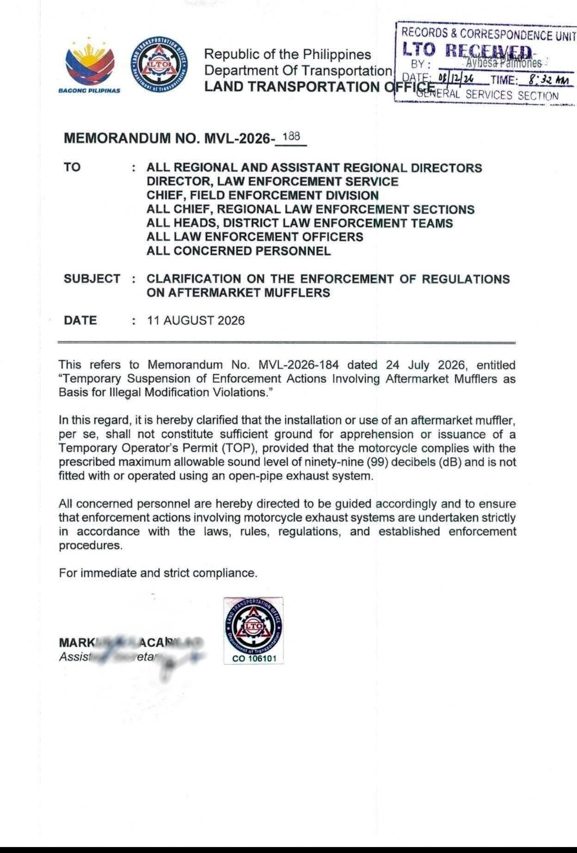
Now, the Land Transportation Office (LTO) is stepping in with Memorandum MVL-2026-188, titled “Clarification on the Enforcement of Regulations on Aftermarket Mufflers.”
The memorandum states:
In this regard, it is hereby clarified that the installation or use of an aftermarket muffler per se, shall not constitute sufficient ground for apprehension or issuance of a Temporary Operator’s Permit (TOP), provided that the motorcycle complies with the prescribed maximum allowable sound level of ninety-nine (99) decibels (dB) and is not fitted with or operated using an open-pipe exhaust system.
In simpler terms, an aftermarket muffler is not automatically a violation and, by itself, is not enough reason to apprehend a rider or issue a Temporary Operator’s Permit (TOP). A motorcycle can use an aftermarket muffler as long as its exhaust noise does not exceed 99 dB and it is not fitted with or operated using an open-pipe exhaust system.
Motorcycle Rights Organization (MRO) said the clarification is the result of nearly two decades of advocacy for the principle that an aftermarket muffler should not automatically be treated as an illegal modification.
The group said the LTO memorandum marks a significant milestone in its push for fair enforcement, due process, and equal protection for motorcycle riders.

Naturally, the next question is, what happens when an LGU has its own anti-modification ordinance?
According to MRO Chairman, Jobert Bolanos, local ordinances cannot supersede national laws and regulations. He said riders can now cite the latest LTO memorandum when contesting apprehensions involving aftermarket mufflers, provided their motorcycles comply with the 99 dB limit and do not use an open-pipe exhaust system.