Riders say NO to MC Lane
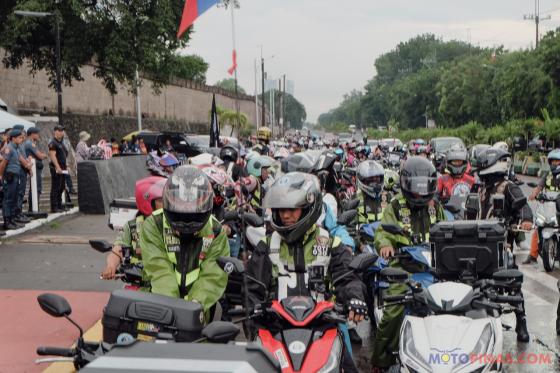
Despite the bad weather yesterday, an estimated 600 to 700 riders converged at the EDSA People Power Monument, subsequently undertaking a Unity Ride along EDSA to the MMDA’s new head office in Julia Vargas, Pasig City. Their objective was to voice their opposition to what they perceive as the unfair and discriminatory implementation of traffic laws, particularly concerning the Motorcycle Lane (MC Lane).
“Ang pinaglalaban namin, since 2012, yung tinatawag natin na Motorcycle Lane. Ngayon na maayos na ang teknolohiya, meron na tayong tinatawag na NCAP (No Contact Apprehension Policy), ang Motorcycle Lane ay hindi na kailangan para i-kurdon yung mga motorsiklo,” says Motorcycle Rights Organization (MRO) Chairman, Jobert Bolanos.
(What we’ve been fighting for, since 2012, is what we call the Motorcycle Lane. Now that technology is in order, we have what we call NCAP (No Contact Apprehension Policy), the Motorcycle Lane is no longer needed to cordon off motorcycles.)
According to the MRO, motorcycle riders are being forced to share a single lane along Commonwealth Avenue, a space that can no longer accommodate the sheer volume of riders. This overcrowding creates a serious road safety hazard, as riders are often sandwiched shoulder-to-shoulder.
“Nakita naman natin, ang patunay yung sa Commonwealth [Avenue], na ang volume ng motorsiklo ay talagang hindi na kayang i-accommodate ng iisang lane. ‘Pag rush hour, apat hangang limang motor nagtatabi-tabi. Ang pagiging delikado nito ay maaaring maghantong sa pagka-matay ng rider,” added Bolanos.
(As we’ve seen, the proof is on Commonwealth [Avenue], that the volume of motorcycles really cannot be accommodated by a single lane. During rush hour, four to five motorcycles ride shoulder-to-shoulder. The danger of this could lead to the death of the rider.)
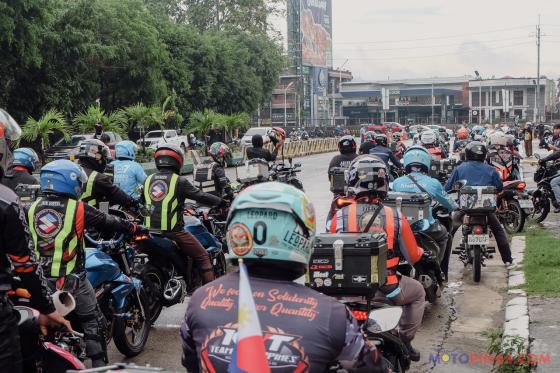
Bolanos expounded on this, explaining that this sardine-like scenario significantly heightens the risk of road crashes, where riders might collide with each other, or worse, fall into the path of a larger vehicle and be run over.
“Because a motorcycle relies on its maneuverability to move out of danger, not to brake. Because it only has two wheels, its traction or stopping power is not the same as a car’s. Every motorcycle requires a margin of safety. If you reduce that margin of safety, the risk increases. When the risk increases, it’s no longer safe; it becomes dangerous [to motorcyclists],” said Bolanos, explaining the dynamics of how motorcycles work.
Forcing motorcycles into a single lane, the group contended, also has significant economic repercussions. Modern motorcycles serve as essential transport for people (motorcycle taxis), food, and critical emergency or life-saving deliveries, making their unrestricted movement vital.