Yamaha showcases new creations at the 2025 Japan Mobility Show
This year’s Japan Mobility Show (JMS) once again highlighted Japan’s finest innovations in mobility, both for today and the future. For Yamaha, the goal is to demonstrate that its vision for future mobility extends beyond two wheels. With the unveiling of the TRICERA proto, the company showcases its innovation in three-wheeled vehicle design to push the boundaries of performance, stability, and freedom in next-generation travel.
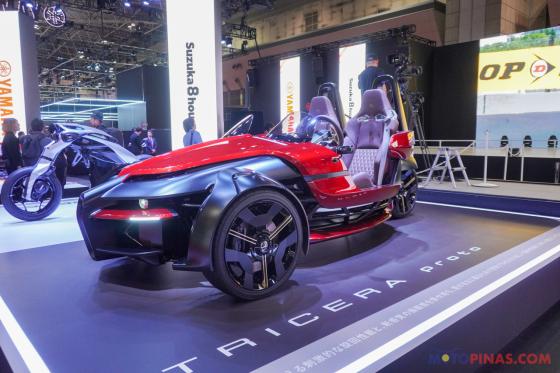
3-wheel steering
The TRICERA proto (proto = prototype) represents Yamaha’s bold exploration of a new dimension in driving pleasure through a three-wheeled, open-top electric autocycle. Developed as a fully functional concept, it features Yamaha’s advanced Three-Wheel Steering System (3WS), which delivers dynamic cornering performance and a unique steering sensation, making the process of mastering it an enjoyable experience in itself.
Drawing inspiration from the responsive handling and mid-corner precision of all-wheel-steering vehicles, Yamaha has fine-tuned the TRICERA’s turning control system from a human-centered research perspective. According to Yamaha, “the result is an innovative driving experience that maximizes rider engagement and achieves an unprecedented sense of oneness between driver and machine.”
Enhancing this immersive experience is Yamaha’s αlive AD sound control device, which modulates and refines the electric motor’s sound to heighten emotional connection and amplify the thrill of every drive.
Visually, the TRICERA proto stands out with its arching center frame that accentuates the vehicle’s three-wheeled configuration.
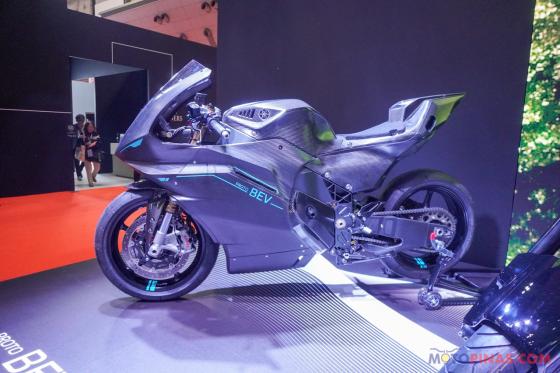
“e-R1”
Developed around the concept of delivering “fun that can only be experienced with a large-capacity battery EV,” the PROTO BEV is a working prototype that showcases Yamaha’s vision for the next generation of electric supersport motorcycles.
By focusing on lightweight construction and compact design, Yamaha says it developed an agile electric motorcycle that fuses its signature handling stability with the smooth, powerful response of an electric powertrain, drawing inspiration from its flagship YZF-R1 superbike.
Yamaha also adds that the PROTO BEV was designed for pure rider engagement, the model features a human-machine interface optimized for track use, with intuitive fingertip controls and an advanced instrument display visualizer paired with a sound feedback system.
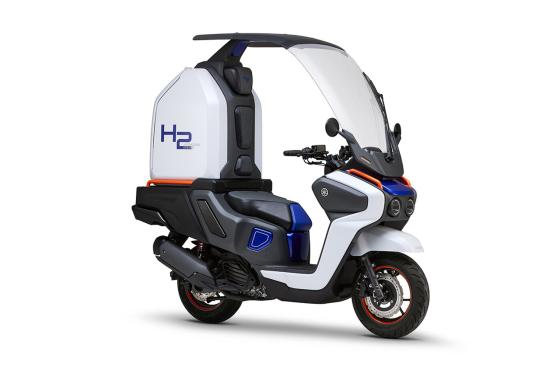
H2-powered, bicycles, etc.
Yamaha also showcased several intriguing prototypes at its booth during the 2025 Japan Mobility Show, including the H2 Buddy Porter Concept—a hydrogen-powered scooter jointly developed with Toyota that envisions a cleaner, more sustainable future for urban mobility.
Also in display were the MOTOROiD:Λ, which has evolved from the self-balancing 2017 prototype to 2023’s MOTOROiD2, which enabled rider-machine communication. The latest MOTOROiD:Λ advances this vision with AI-driven reinforcement learning, allowing the bike to train in virtual environments, adapt in the real world, and move with optimized, organic precision, pioneering a new era of intelligent, evolving mobility.
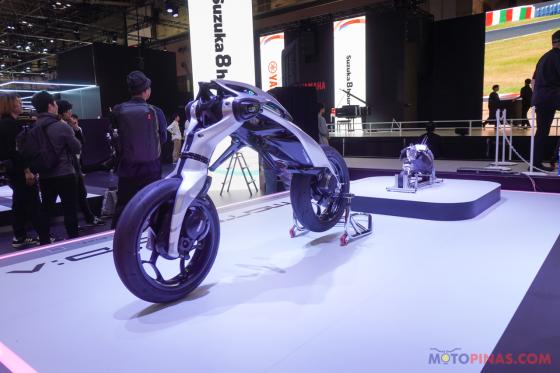
Also on display were the Y-00B: Base/Bricolage pedal-assisted bicycles, the PROTO HEV hybrid scooter, and the PROTO PHEV (plug-in hybrid electric motorcycle) that appears to be based on Yamaha’s MT-09 platform.