Failing to yield at a pedestrian right of way carries a PHP 1,000 penalty
Welcome to the Philippines, where many traffic laws are treated less like rules and more like suggestions, followed only if the motorist feels like it or if there’s a visible traffic enforcer nearby. Among the most ignored and routinely violated of these is the law on pedestrian right of way.
For those who may not know, or perhaps never learned it in the first place because their driver’s licenses were acquired from fixers, Republic Act No. 4136, or the Land Transportation and Traffic Code, explicitly grants pedestrians the right of way, particularly at marked crosswalks, more commonly known as pedestrian lanes. These are not decorative road markings. They are legal zones where motorists are required to slow down, stop, and yield to people on foot.
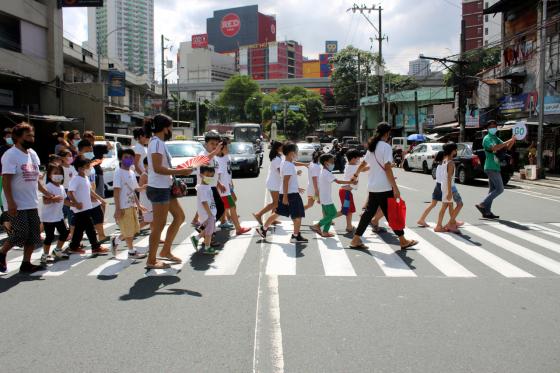
Section 42(c) of RA 4136 explicitly says that drivers must yield the right of way to pedestrians crossing a public road within a marked crosswalk in business or residential districts. This means vehicles must slow down or stop to let pedestrians cross safely.
In Baguio City, the rules go a step further with Ordinance No. 7, Series of 2010, more widely known as the “King of the Road Ordinance.” Under this measure, motorists are required to come to a full five-second stop before a pedestrian lane to give priority to people crossing. The ordinance also strictly prohibits vehicles from blocking any part of the pedestrian lane and imposes fines ranging from PHP 1,000 to PHP 3,000 on violators.
Meanwhile, in Metro Manila, the Metropolitan Manila Development Authority (MMDA) passed Resolution No. 13-13 in 2013, urging local government units (LGUs) to enact their own ordinances aimed at improving pedestrian safety and clearing sidewalks of obstructions. The resolution emphasizes stronger pedestrian protection, regulation of sidewalk vendors, and the provision of designated bicycle lanes.
The “Republic of Makati” is also notably strict when it comes to pedestrian safety. Under Article 20, Section 105 of the Makati Traffic Code, drivers are required to approach pedestrian crossings at a safe speed that allows them to stop before the lane and to yield to pedestrians already crossing. Vehicles are likewise prohibited from blocking pedestrian lanes at any time.
Motorists who violate pedestrian right-of-way rules in Makati face penalties ranging from PHP 200 to as much as PHP 2,500, with repeated or serious offenses potentially leading to driver’s license cancellation.
So, how much is the penalty if it’s the LTO who caught you?
For motorists who drive or ride daily, the pattern is hard to miss. The most common violators of pedestrian lanes or those who fail to yield the right of way or block crossings altogether, are often public utility vehicle (PUV) drivers and motorcycle riders.
In the case of PUVs, pedestrian lanes are frequently treated as makeshift terminals as pedestrians are already crossing, so they might as well be picked up. Motorcycle riders, meanwhile, often occupy pedestrian lanes while waiting for the traffic light to turn green after filtering to the front at stoplights and intersections.
According to the Land Transportation Office (LTO), failure to yield at a pedestrian right of way is punishable under Joint Administrative Order 2014-01, Section J (25) with a PHP 1,000 fine. However, the consequences escalate sharply when a pedestrian is injured.
Just this month, the LTO issued a Show Cause Order (SCO) against a driver who failed to yield to a pedestrian crossing at a marked pedestrian lane. The vehicle struck the pedestrian, resulting in minor injuries. While the driver was charged with Failure to Yield the Right of Way to a Pedestrian, the case did not end there. Because the violation resulted in injury, the driver may also face an Improper Person to Operate a Motor Vehicle charge, which is an offense that can lead to driver’s license revocation.
“Pedestrian safety should be the first priority of all drivers on the road. Violating laws related to pedestrian lanes and the lack of concern for the victim after the incident is unacceptable,” said LTO Chief, Marcus Lacanilao in a statement related to that incident.